
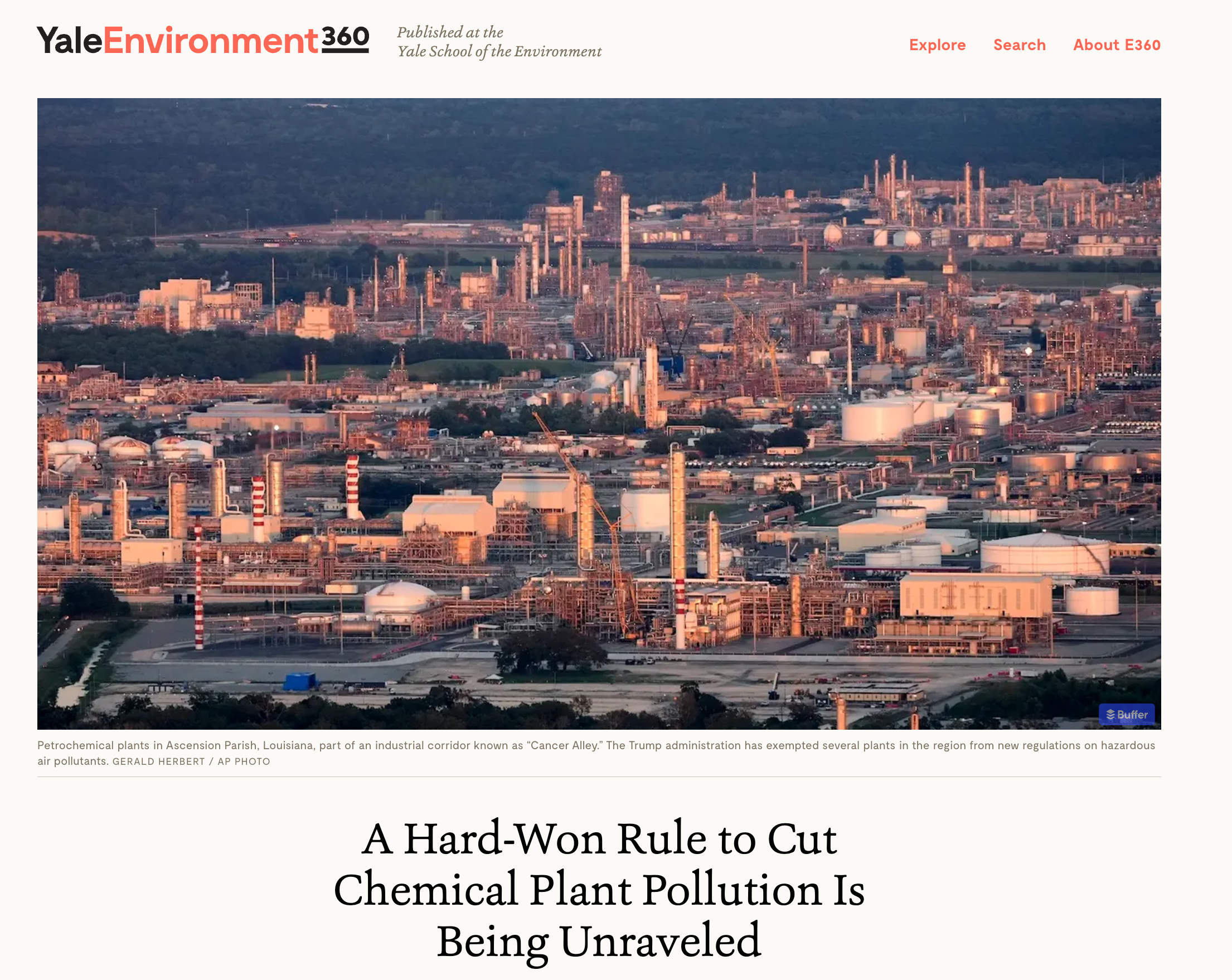
A Hard-Won Rule to Cut Chemical Plant Pollution Is Being Unraveled
YALE ENVIRONMENT 360
In 2024, the Biden administration enacted wide-ranging regulations to protect communities near petrochemical plants from air toxics. The Trump administration has since granted exemptions to scores of polluting facilities and is working to rewrite the long-awaited rule.
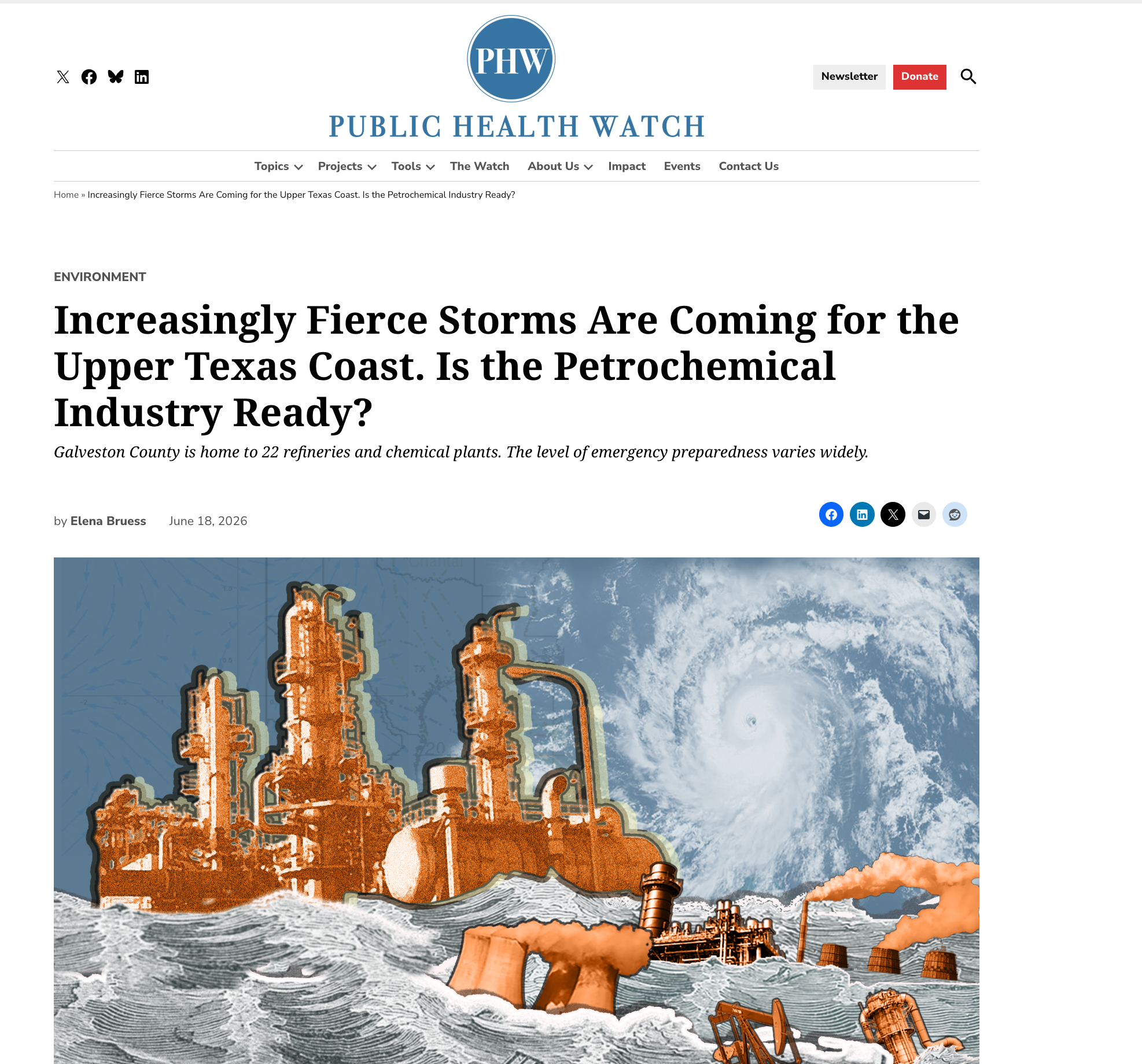
Increasingly Fierce Storms Are Coming for the Upper Texas Coast. Is the Petrochemical Industry Ready?
PUBLIC HEALTH WATCH
Nearly two decades had passed since the storm. For many, the memory of what had happened on Goat Island had largely vanished into the Gulf of Mexico.
Instead, what residents remembered that year were the piles of boats and cars washed up along the highway to Galveston and the twisted mounds of debris where homes once stood. It was late summer 2008, and Hurricane Ike had just struck, decimating parts of the upper Texas Gulf Coast.
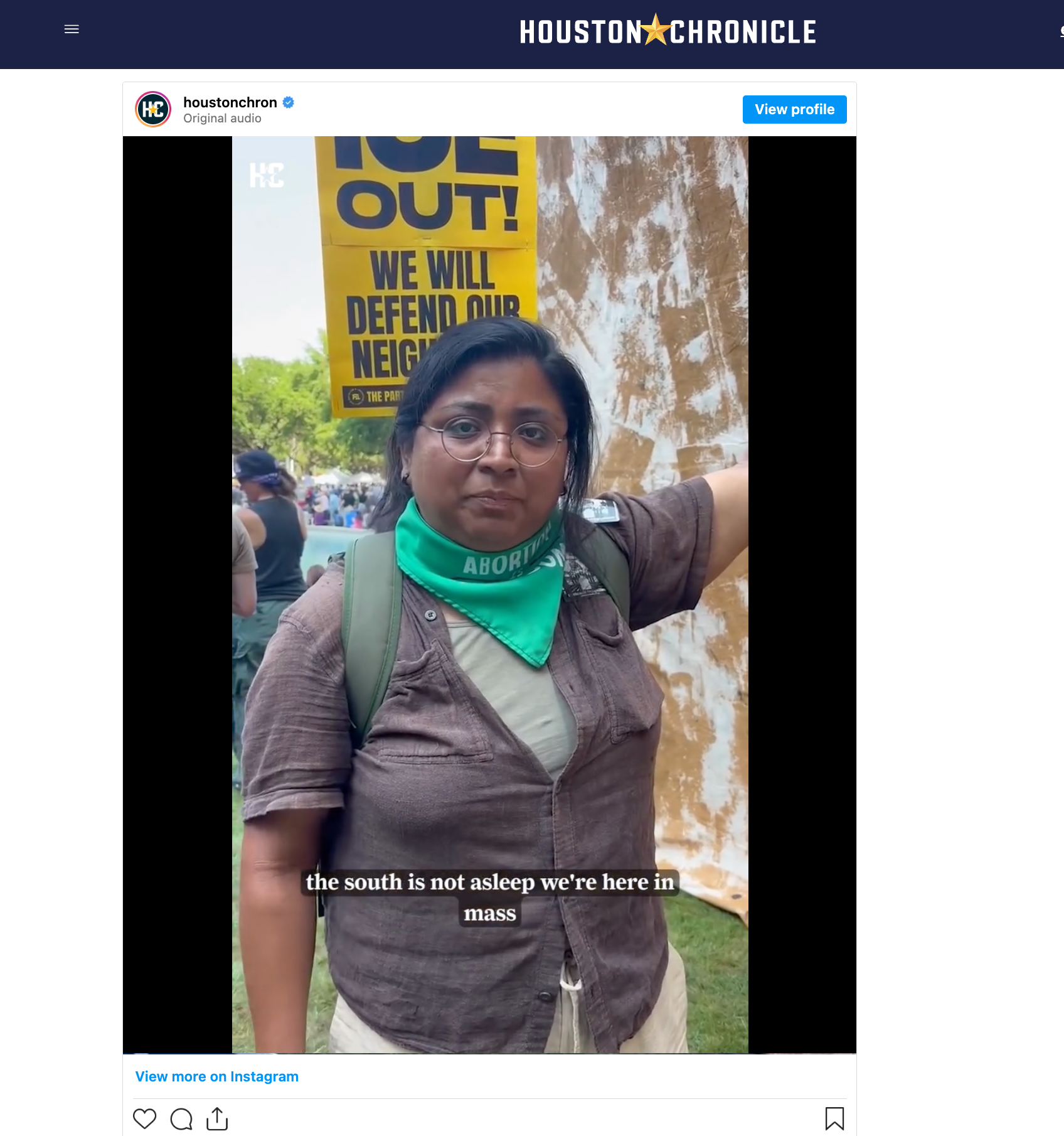
Demonstrators turn out by the thousands for No Kings rally against Trump administration in downtown Houston
THE HOUSTON CHRONICLE
“It’s our lives that are at stake,” Arellano said. “It’s our families that will suffer at the end of the day, and it’s our youth that will get stolen in order to supply soldiers for this war.”
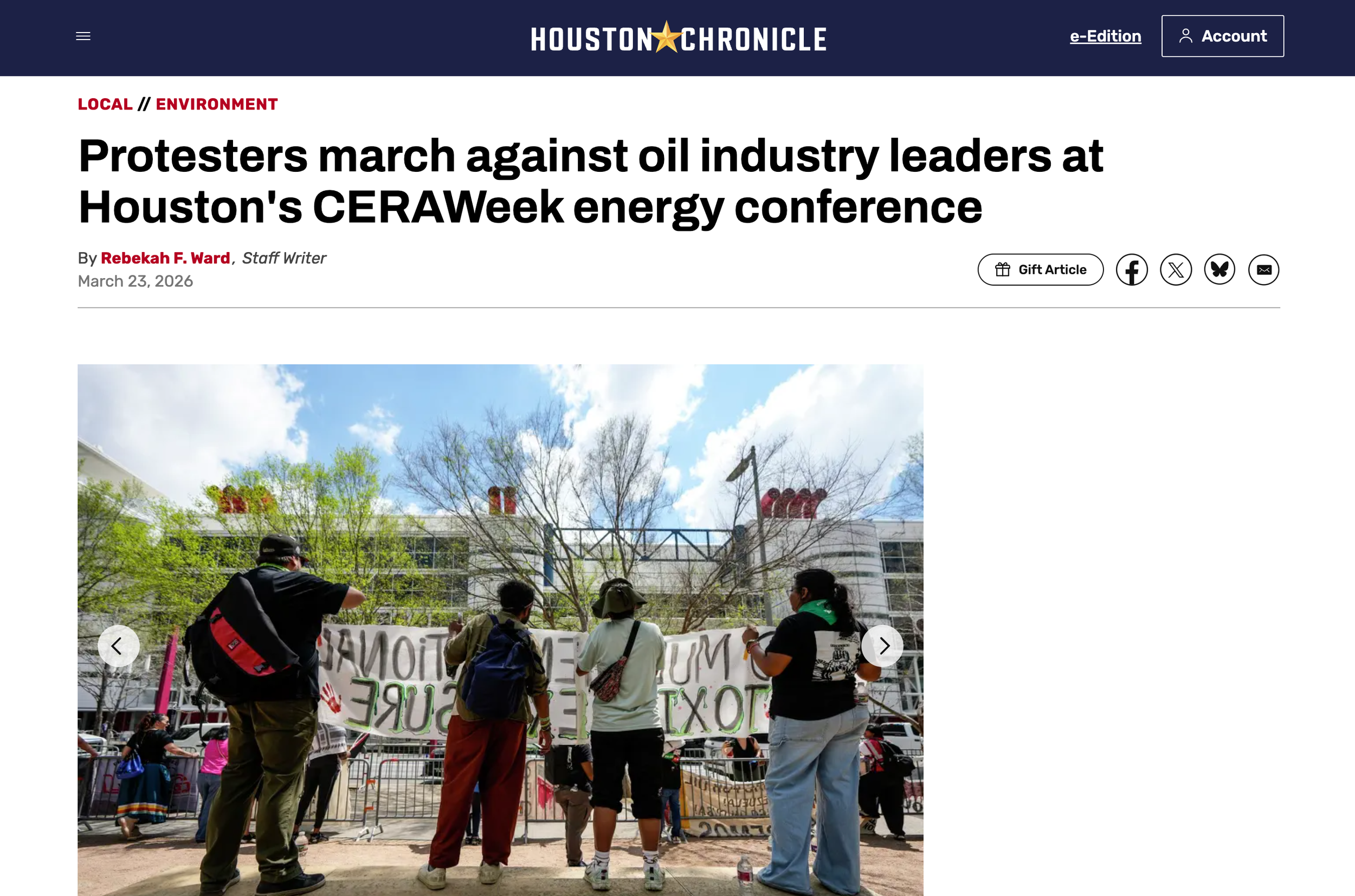
Protesters march against oil industry leaders at Houston's CERAWeek energy conference
THE HOUSTON CHRONICLE
"What's going on at CERAWeek in the George R. Brown Convention Center right now is a bunch of CEOs, a bunch of multinational corporations making plans to put facilities in our backyards that we won't find out about until years from now, when they're coming to seek a permit. They think that they have the right to our air, the right to our water, the right to our bodies,"
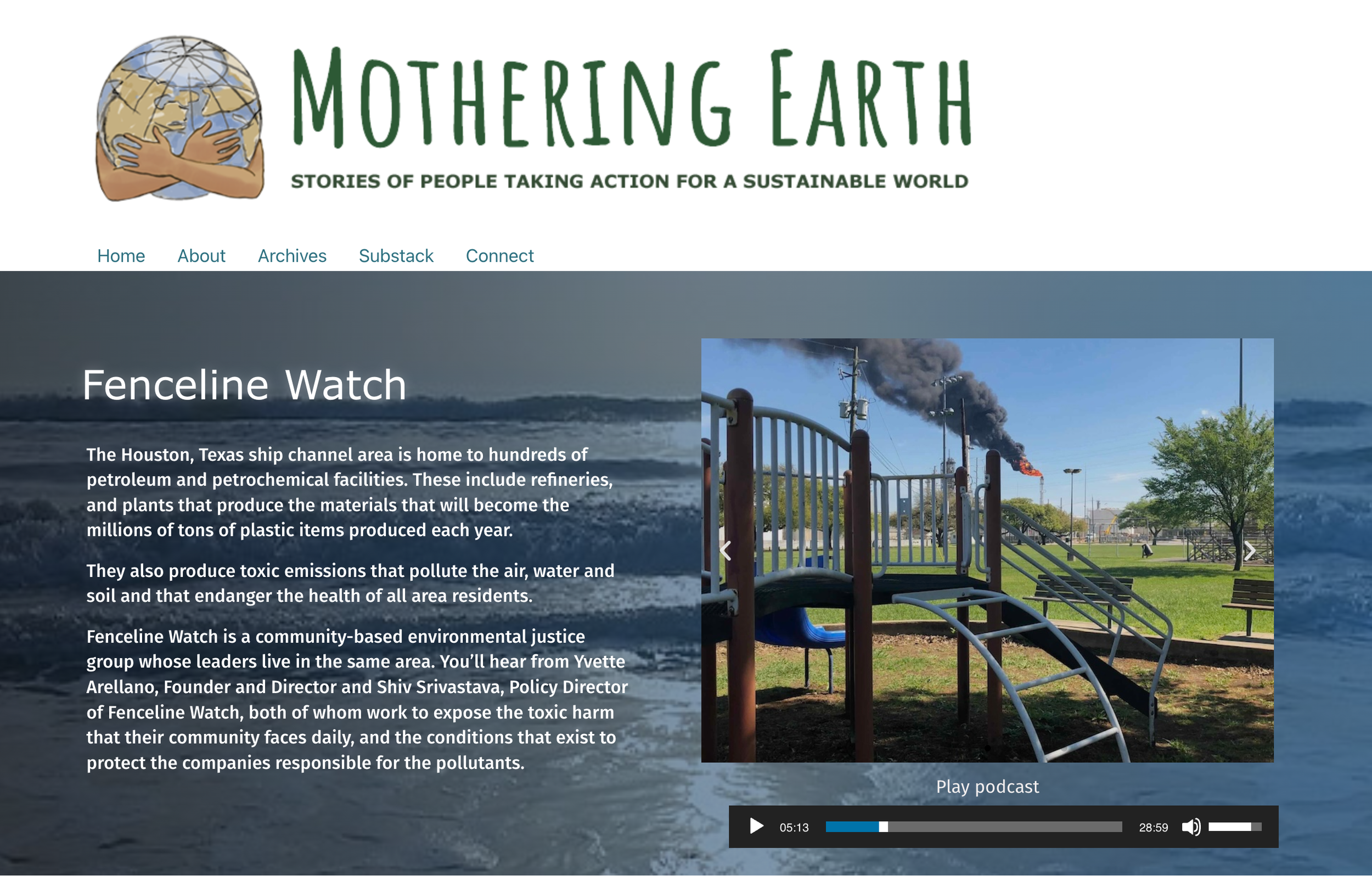
Mothering Earth Podcast
MOTHERING EARTH PODCAST
Fenceline Watch Founder and Director, Yvette Arellano, and Policy Director, Shiv Srivastava, speak on the toxic harm our community faces daily, and the conditions that exist to protect the companies responsible for the pollutants.
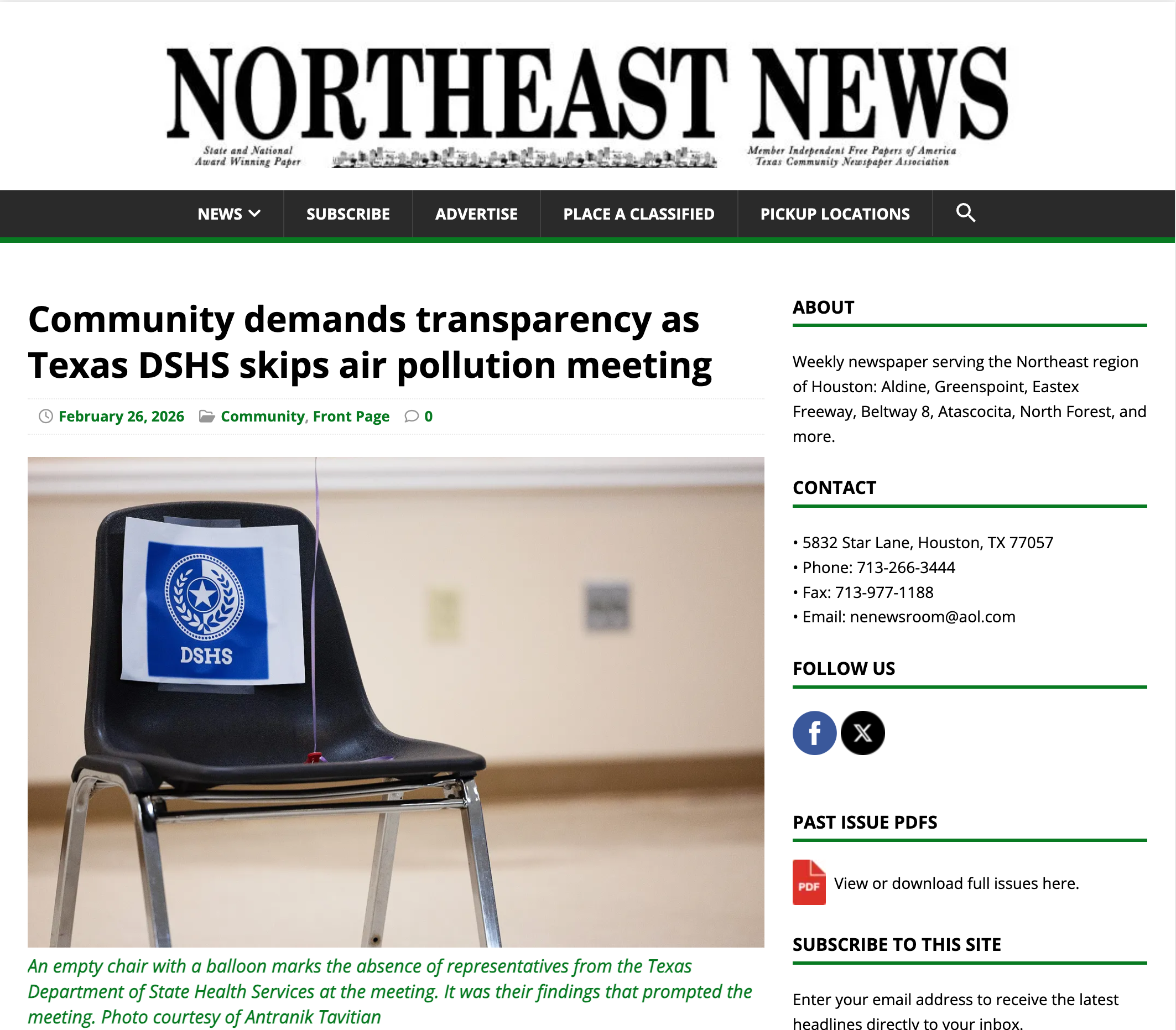
Community demands transparency as Texas DSHS skips air pollution meeting
NORTHEAST NEWS
Community leaders, health experts, and residents gathered at the San Jacinto Community Center in Highlands last Thursday to confront the findings of a recent Texas Department of State Health Services (DSHS) cancer study, which revealed significantly elevated rates of leukemia, lung and bronchus cancer, lymphoma, and cervical cancer across a massive area of East Harris County. The panel, organized as a follow-up to Public Health Watch’s October 2025 investigation, brought together advocates and experts to demand greater transparency and immediate action. There was only one problem—the invited guests, Texas Department of State Health Services, was a no-show.
Coca-Cola under fire after report exposes its ties to controversial industry: 'The cost is irreversible damage to our children's health'
THE COOL DOWN
"From toxic extraction in the Permian Basin to poisonous production along the Houston Ship Channel, the cost is irreversible damage to our children's health — low birth weights and reproductive and developmental harm — spanning generations,"
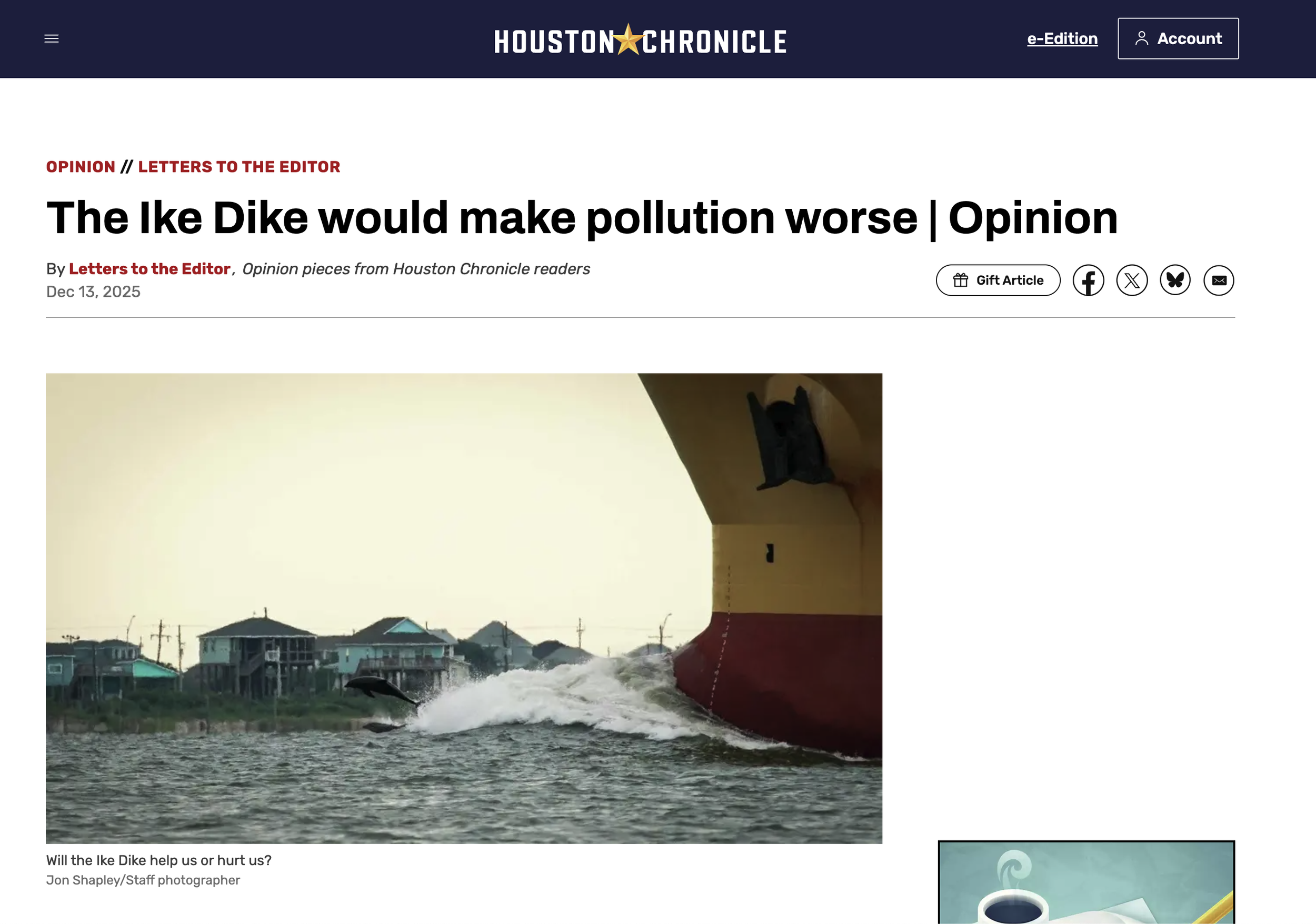
The Ike Dike Would Make Pollution Worse
HOUSTON CHRONICLE
Regarding “Houston Chronicle: John Cornyn: Houston needs the Coastal Texas Project,” (Dec. 05): Senator John Cornyn is pushing lawmakers to fund the $34 billion Coastal Texas Project, commonly known as the Ike Dike, to “build a coastal storm barrier to protect at-risk petrochemical infrastructure and the Texas Gulf Coast.” But it's this same industry that makes disasters like storms and hurricanes worse. Instead of requiring the petrochemical industry to pay to protect their own plants — and protect the people who have lived here long before industry moved in — Sen. Cornyn offers up our tax dollars.

Ineos faces new lawsuit over Project One as NGOs cite “alarming” plastic, emission and health risks
PACKAGING INSIGHTS
NGOs and community groups have launched a new lawsuit against Ineos’s plastics facility in Antwerp, Belgium, and warn of fracking health issues, accelerated carbon emissions, and early deaths from pollution. We speak to Ineos and environmental charity ClientEarth to hear more about this latest lawsuit.
Project One, which is currently under construction, is an ethane cracker representing the largest investment in the European chemical sector in over 25 years. The plant will produce ethylene, a key chemical building block for industries such as packaging, automotive, building materials, and medical devices.
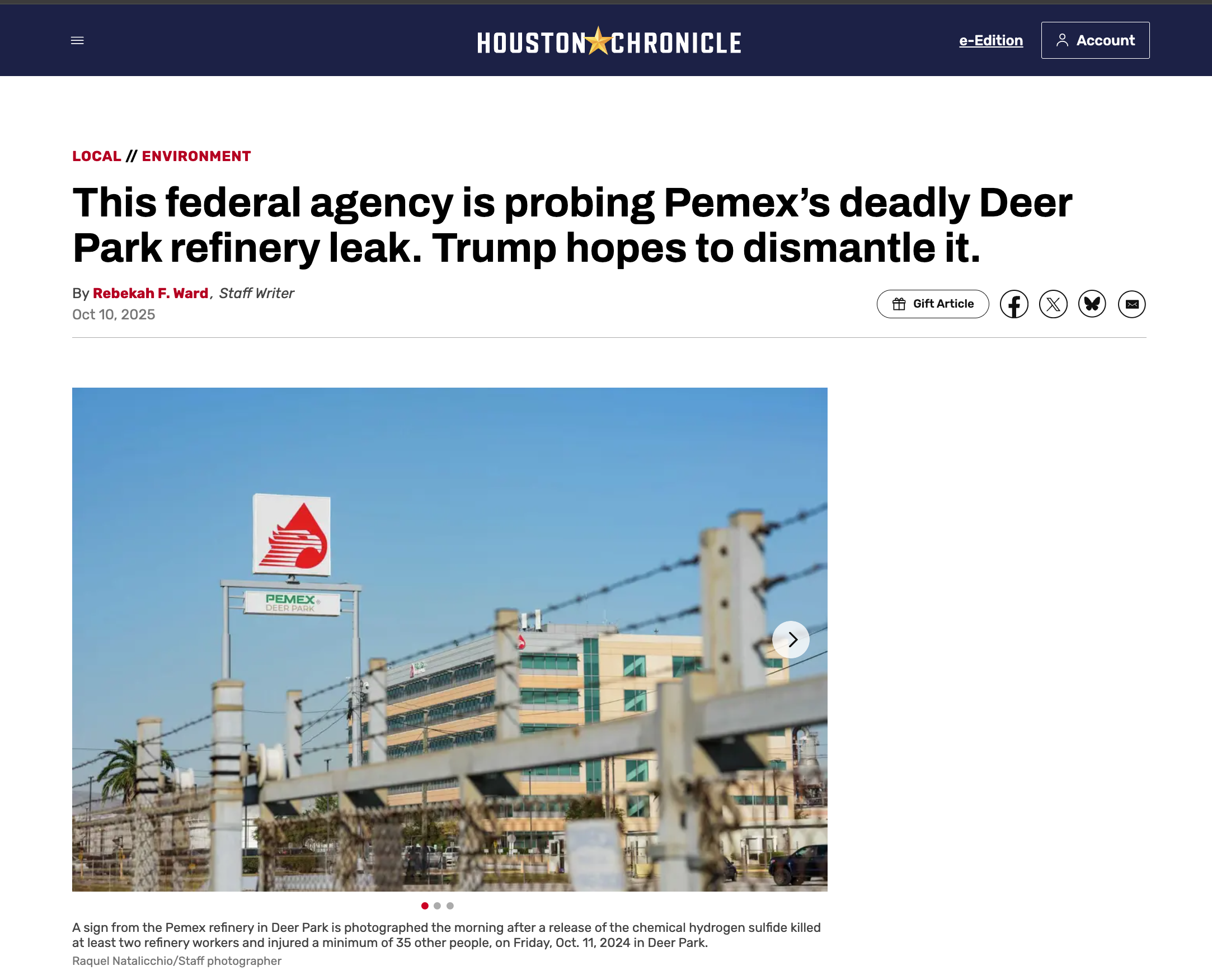
This federal agency is probing Pemex’s deadly Deer Park refinery leak. Trump hopes to dismantle it.
HOUSTON CHRONICLE
When the Chemical Safety Board revealed how Jose Wilfredo Perez Jr. died last year trying to flee a toxic plume of hydrogen sulfide wafting through Pemex’s Deer Park oil refinery, the federal agency offered Houstonians their first detailed look at the tragedy.
CSB investigators discovered that Perez, a 28-year-old contractor, and a colleague hadn’t carried respirators while completing less-toxic work in a unit about 250 feet downwind of the chemical release. The pair started running only once they heard alarms, which did not sound right after the release began.
Perez was later found on the ground, “fatally injured from hydrogen sulfide poisoning,” the federal oversight agency said in a March 2025 update.
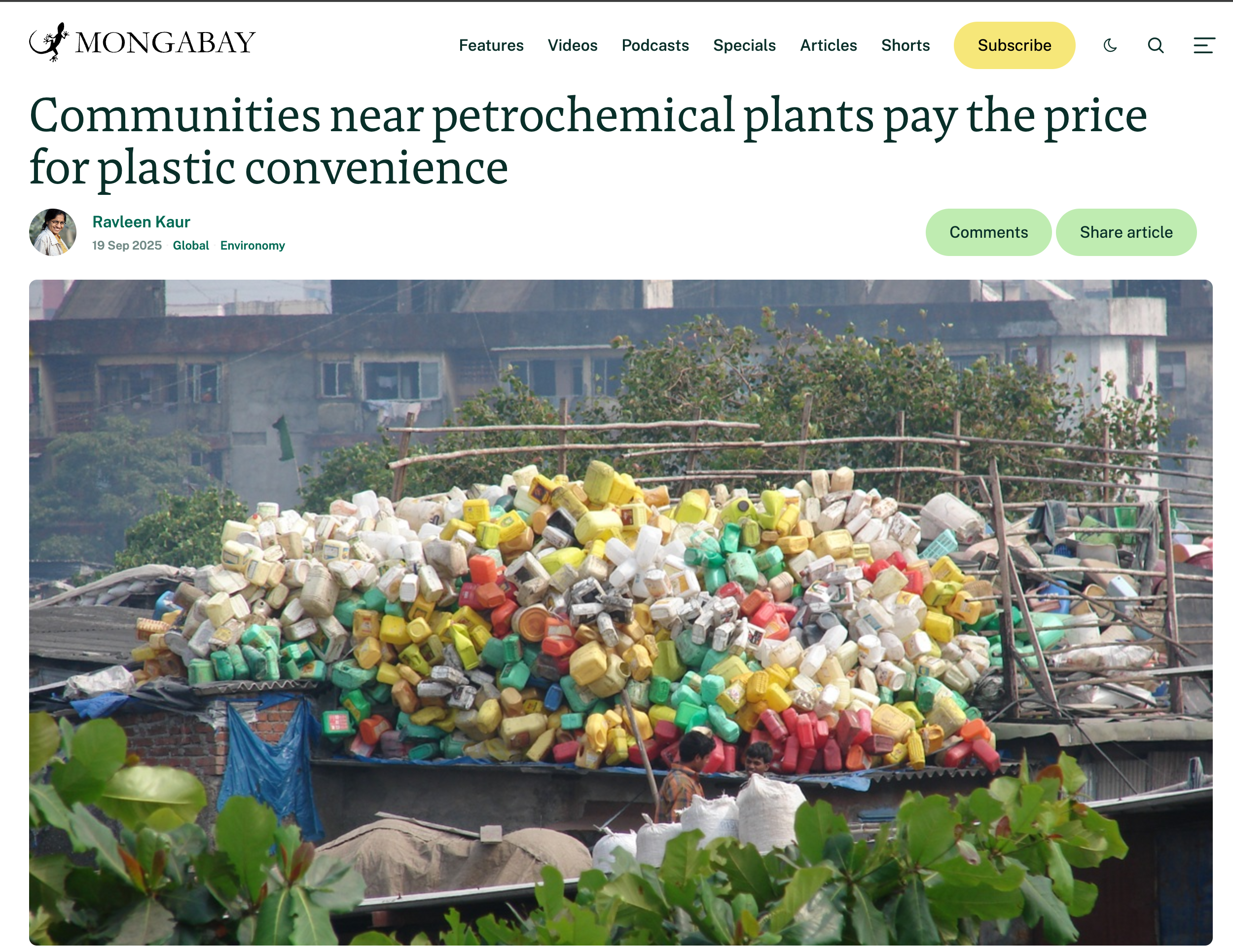
Communities near petrochemical plants pay the price for plastic convenience
MONGABAY
Yvette Arellano had a nosebleed twice during the 10-day-long Global Plastic Treaty negotiations in Geneva in August this year. “This is frequent. Apart from eczema and hormonal imbalance. I can’t have children unless I put massive resources into it,” said Arellano, a Mexican-American who stays in Texas’ Houston city in the United States of America. “In fact, it was over my skin condition that I would have a conversation with my neighbours and get to know they were suffering too,” she said.
Thousands of miles away, on the western coast of India, a casual survey in mid-2024 found that in Lakhigam village near Dahej in Gujarat’s Bharuch district respiratory illness, skin and hearing issues were common and at least 50 cases of cancer were found in a population of 5000. “This is thanks to the open-air conveyor belt that transports coal. The village remains coated in soot, and because of the noise and foul smell, it is impossible to sleep without shutting doors,” said Kamlesh Madhiwala, an advocate and president of the Samast Bharuch Jilla Machimar Samaj, an association fighting for fishers’ rights.
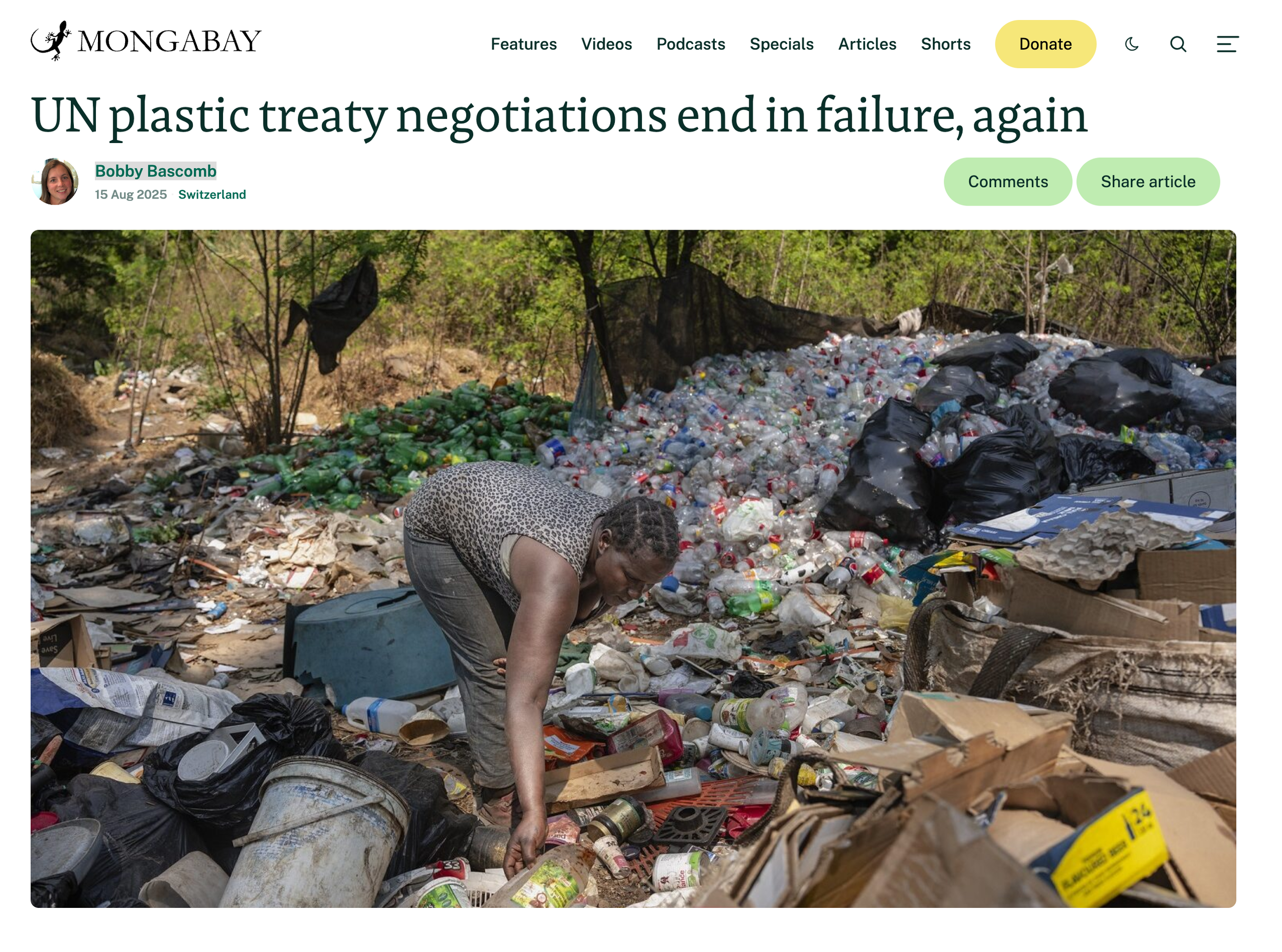
UN plastic treaty negotiations end in failure, again
MONGABAY
Representatives from 184 countries recently gathered in Geneva, Switzerland, to tackle the growing plastic crisis. The Intergovernmental Negotiating Committee meeting (INC 5.2) went into overtime but failed to produce an agreement.
Two main issues were supposed to be resolved by this, the last scheduled round of negotiations: whether the treaty should include a cap on the production of new plastic and how to address concerns about chemicals in plastic.
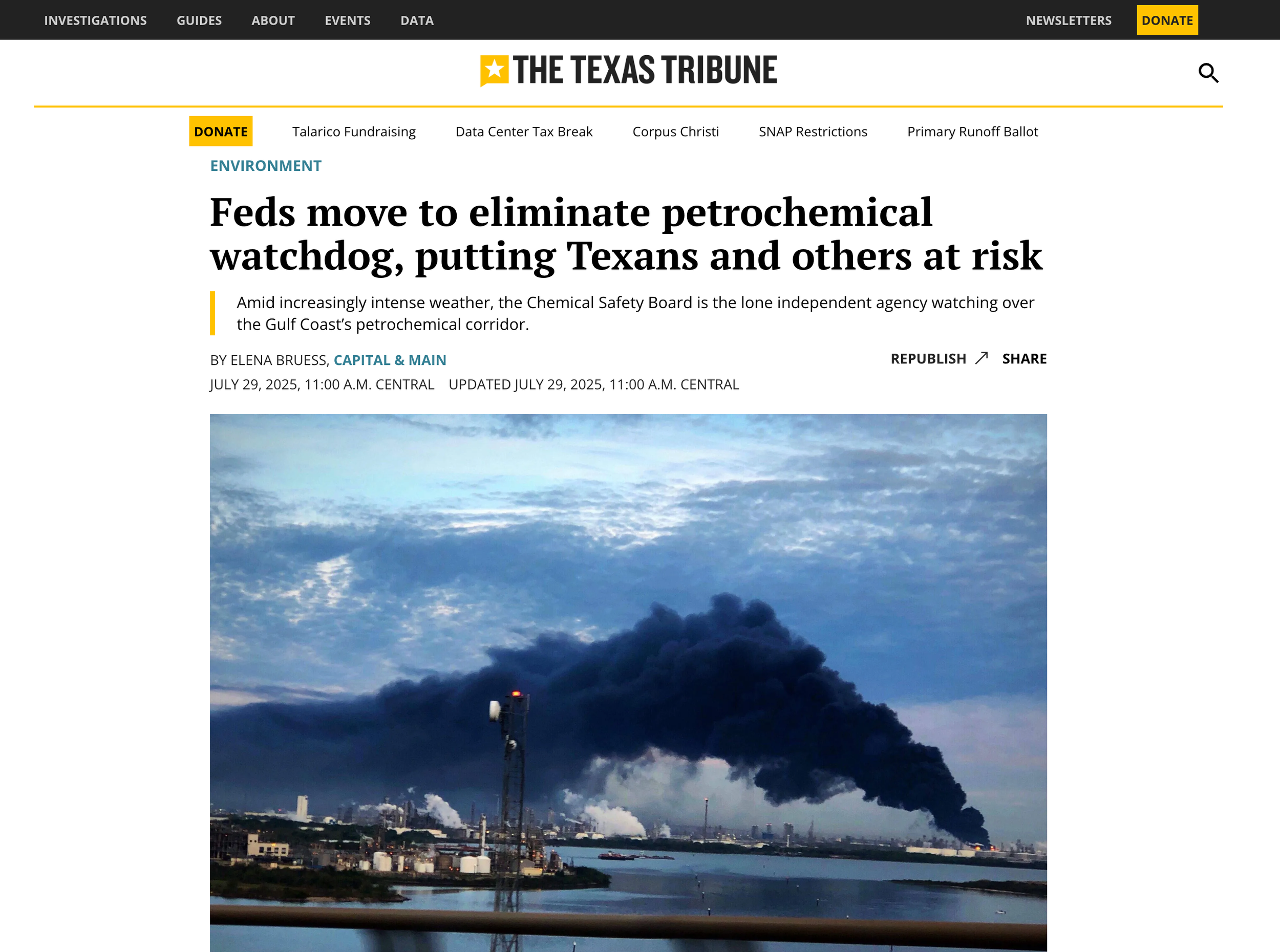
Feds move to eliminate petrochemical watchdog, putting Texans and others at risk
THE TEXAS TRIBUNE
Even today, more than five years later, residents still talk about the fire. The chemical facility burned for three days, leaked toxic runoff into the waterways, forced schools and businesses to close and prompted a shelter-in-place order for everyone in Deer Park — a city just southeast of Houston in Texas’ crowded petrochemical corridor.
Eventually, after a thick layer of pollution covered the area for days, residents learned that a tank at the Intercontinental Terminals Co. had erupted in flames and that employees had been unable to contain it. Following the event, the U.S. Chemical Safety and Hazard Investigation Board, an independent and nonregulatory federal agency, opened an investigation, finding that a lack of proper safeguards, among other issues, was to blame.
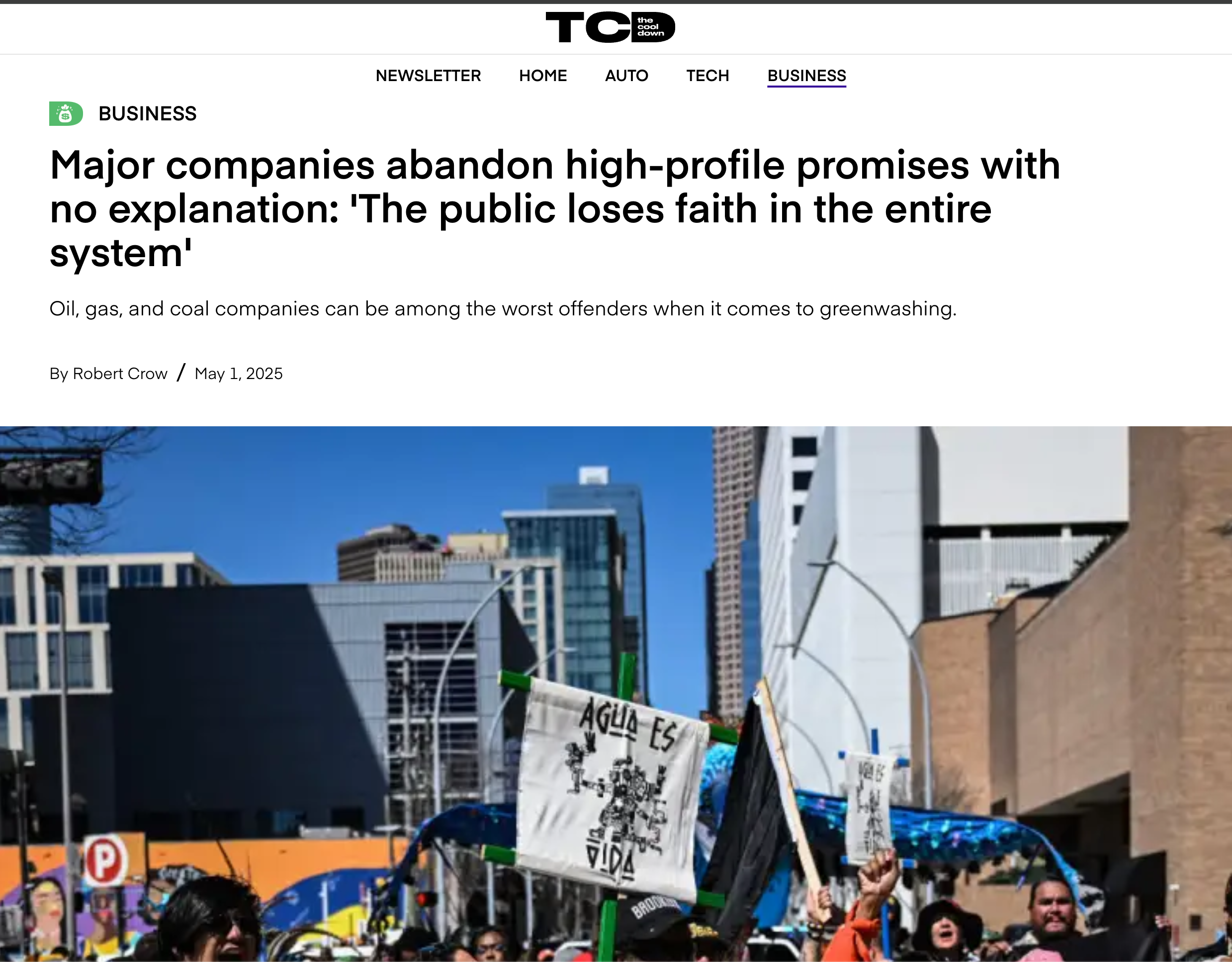
Major companies abandon high-profile promises with no explanation: 'The public loses faith in the entire system'
Numerous companies announced at a prominent energy conference in March that they will invest more heavily in oil and gas, scaling back past commitments to renewables. The news has drawn criticism from environmental advocates.
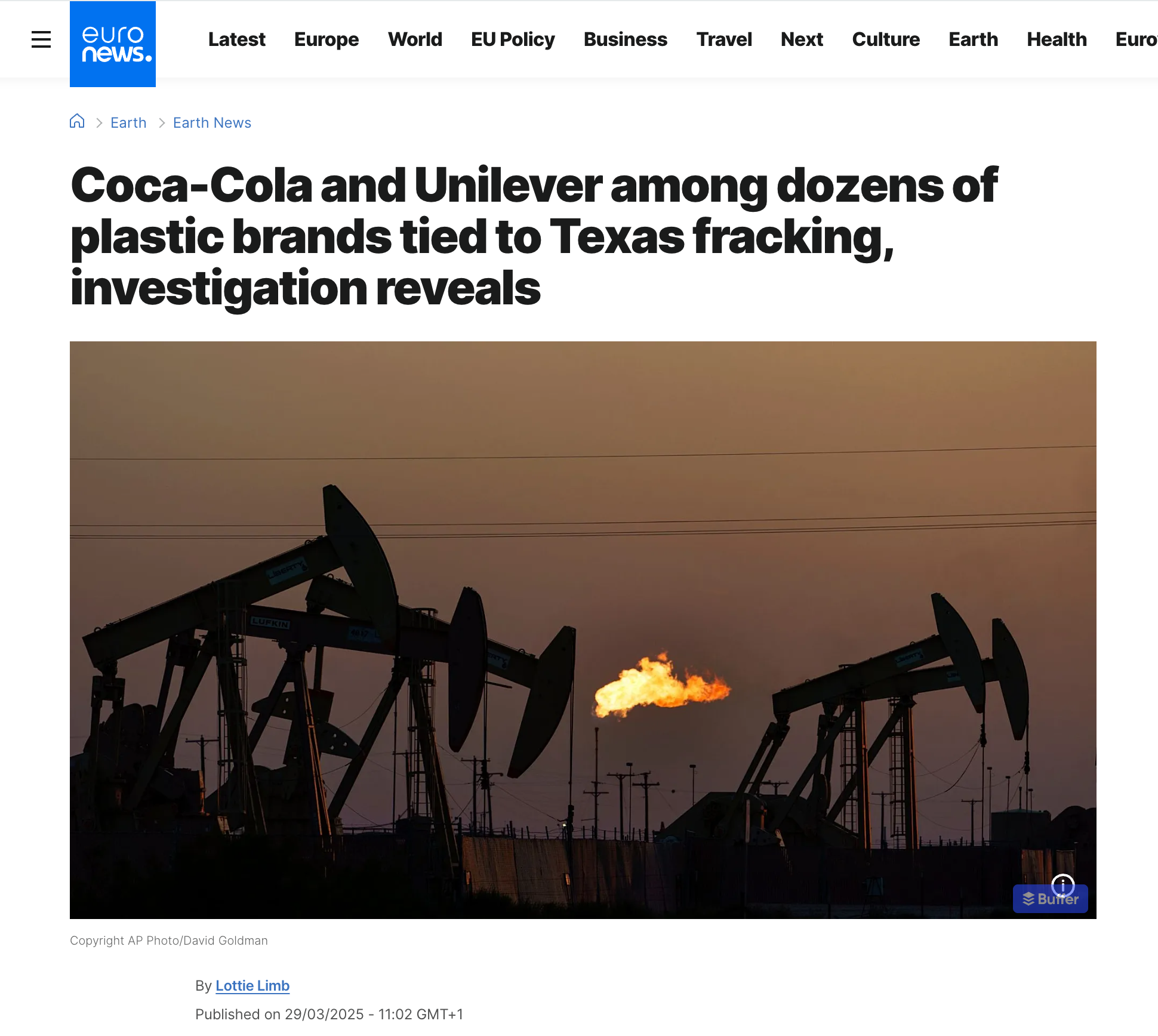
Coca-Cola and Unilever among dozens of plastic brands tied to Texas fracking, investigation reveals
More than 25 major consumer brands and petrochemicals have been traced to fracking in the Permian Basin, one of the world’s ‘carbon bombs’.
Community activists plead to be heard through “closed doors” outside nation’s top energy conference
ENVIRONMENTAL HEALTH NEWS
HOUSTON — Climate activists expressed concern that discussions behind closed doors at the nation’s largest energy conference, CERAWeek by S&P Global, will further contribute to environmental health risks.
As energy executives and political leaders across the nation convened for the conference in Houston, Texas this week to discuss the future of energy, representatives from the Gulf Coast, Rio Grande Valley, Ohio River Valley, and Cancer Alley highlighted the fossil fuel industry's impact in their communities.
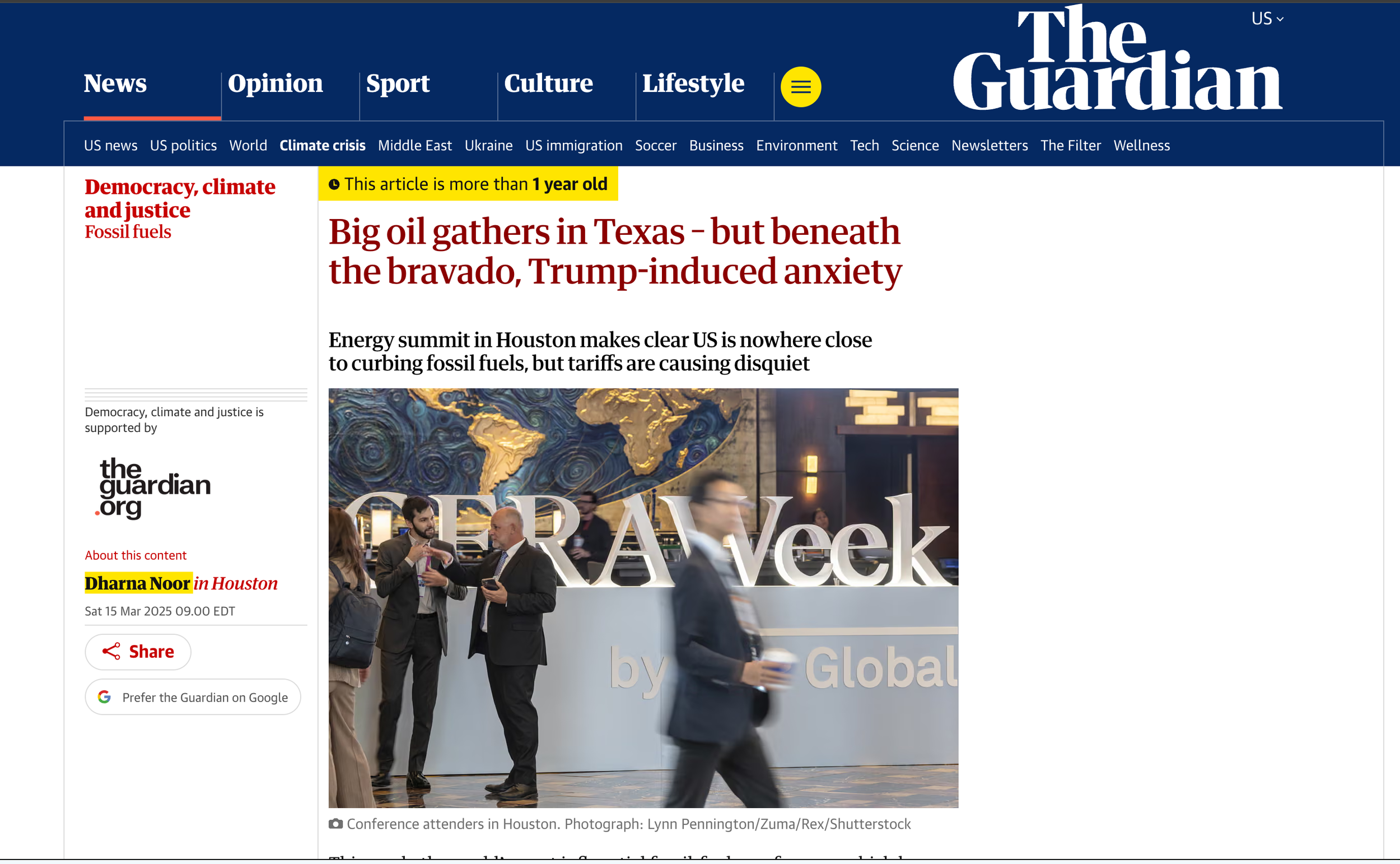
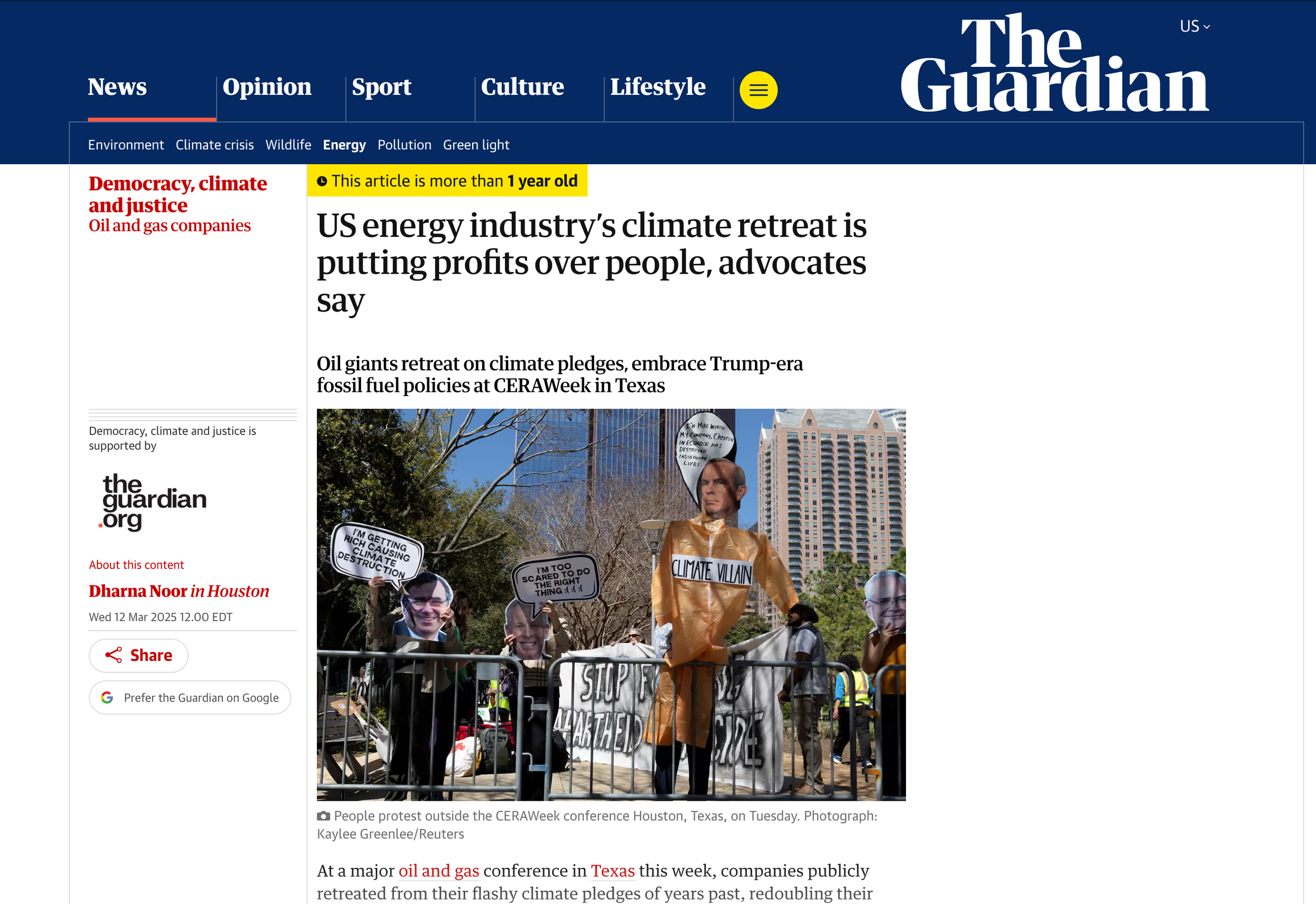
US energy industry’s climate retreat is putting profits over people, advocates say
The Guardian
At a major oil and gas conference in Texas this week, companies publicly retreated from their flashy climate pledges of years past, redoubling their commitment to planet-warming fossil fuels.
The withdrawals illustrate the companies’ allegiance not to ordinary Americans, but to their shareholders and the climate-skeptical Trump administration, advocates said.
“We didn’t necessarily feel that those climate goals were really being done in a sincere, earnest way in the first place,” said Shiv Srivastava, an organizer and policy researcher with the Houston-based environmental justice organization Fenceline Watch. “It’s bad that they’re walking them back, but the problem was always that they could choose to walk them back if they wanted.”
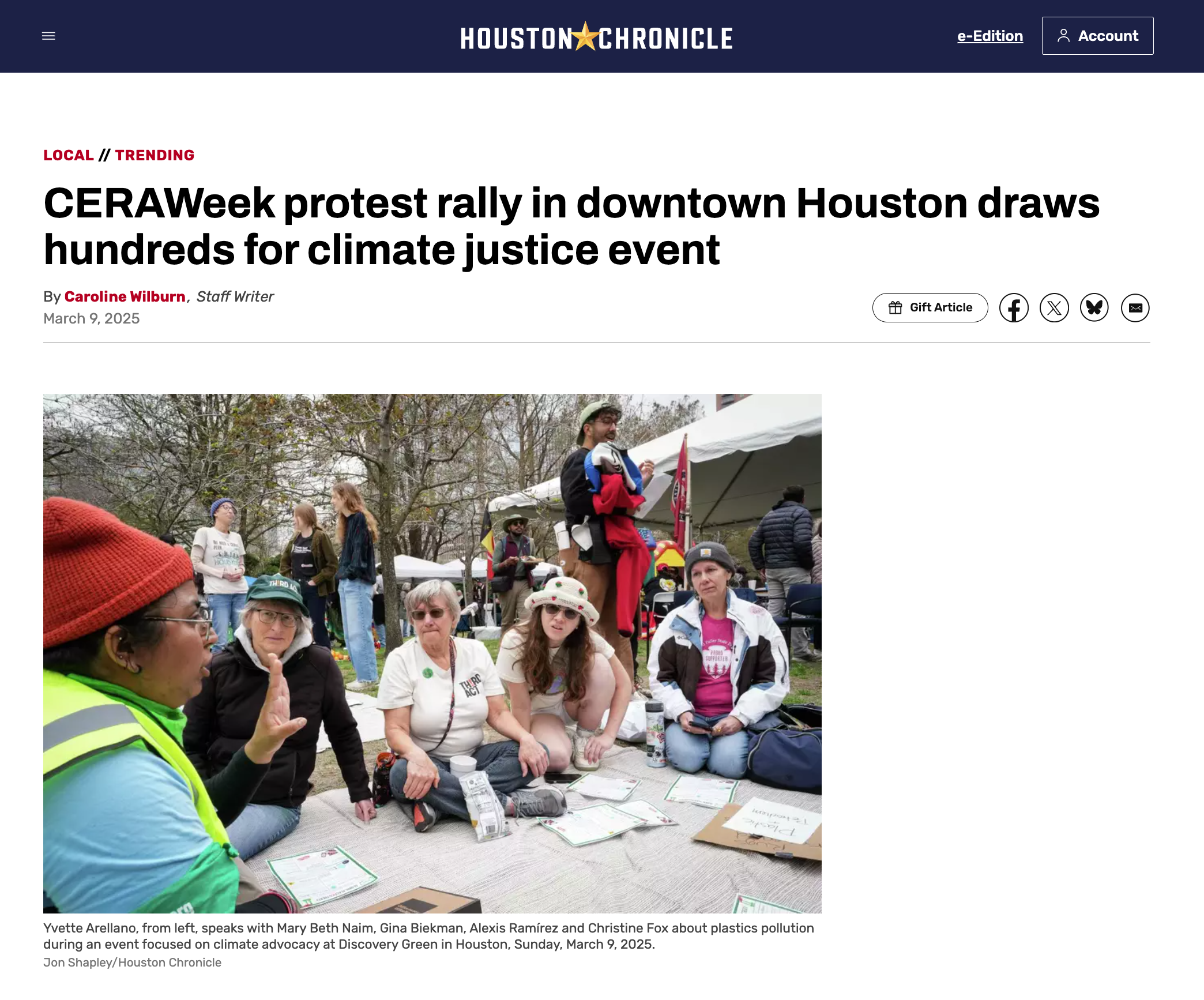
CERAWeek protest rally in downtown Houston draws hundreds for climate justice event
THE HOUSTON CHRONICLE
Hundreds gathered in downtown Houston’s Discovery Green Park Sunday to protest oil and gas company executives attending the upcoming CERAWeek by S&P Global conference.
The community-focused climate justice event, “Sunday for the Future,” drew people from around the state and country for free music, food and workshops, with the goal of educating attendees on the role large energy companies play in Houston’s ongoing struggle with climate disasters. Sunday’s gathering kicked off a week of activism events planned by Future Generations in response to CERA Week, including a rally and march in downtown Houston on Monday.
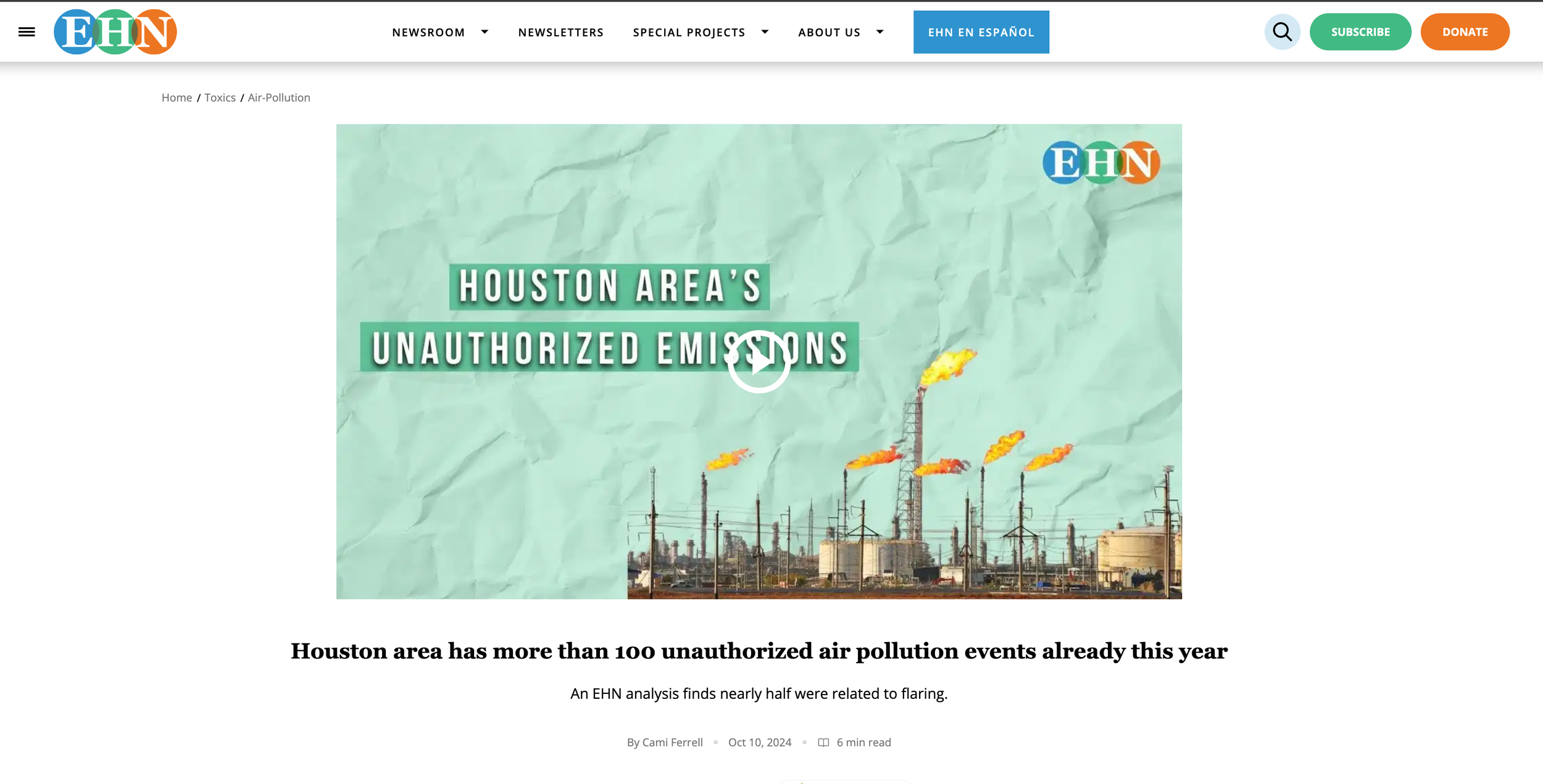
Houston area has more than 100 unauthorized air pollution events already this year
ENVIRONMENTAL HEALTH NEWS
HOUSTON — It was just after noon on August 26, 2024, when Shiv Srivastava recorded the skyline of Houston’s East End while an industrial flare from TPC Group roared in the distance after power loss.
Srivastava is the policy director at Fenceline Watch, an environmental nonprofit based in Houston’s East End. As the cloud of black smoke expanded over the downtown skyline, he worked with Yvette Arellano, Fenceline Watch’s executive director, to research air quality updates to share with community members on social media. It was not the first time they responded to air pollution problems like this one.